We use cookies on this website to ensure its proper functioning and to improve the quality of our services. Cookie Policy


Tags and nutritional info are auto-generated and may be inaccurate. Always check the full ingredient list before cooking.


Whisk together the besan and kesar food color in a large bowl.
Gradually pour in water while whisking continuously to form a smooth, lump-free batter with a thin, free-flowing consistency.
Heat oil in a wide frying pan over high heat until piping hot.
Pour a spoonful of batter into the center of the specialized 0.5mm ladle held over the pan.
Hit the handle of the ladle hard against your support base to splash tiny, pearl-like droplets into the hot oil.
Fry on high flame until crisp, then scoop out the boondi quickly using a fine tea strainer and transfer to a large mesh sieve to drain excess oil.
Combine sugar and water in a wide pan and bring to a boil on high flame until fully dissolved.
Add the patika (or lemon juice) and kesar food color.
Once the syrup reaches a light single-thread consistency, turn down to medium heat and add all the fried boondi.
Stir and cook continuously until the boondi absorbs about 90% of the syrup and softens.
Flatten the mixture evenly across the pan with a spatula to trap the steam.
Turn off the flame and cover the boondi mixture directly with paper towels/tissues.
Sprinkle 2 tbsp of water over the tissues to seal in moisture and fix the steam.
Cover with a lid and let it rest undisturbed for 30 minutes.
Remove the lid and paper towels. Mix in cardamom powder, cashews, and ghee.
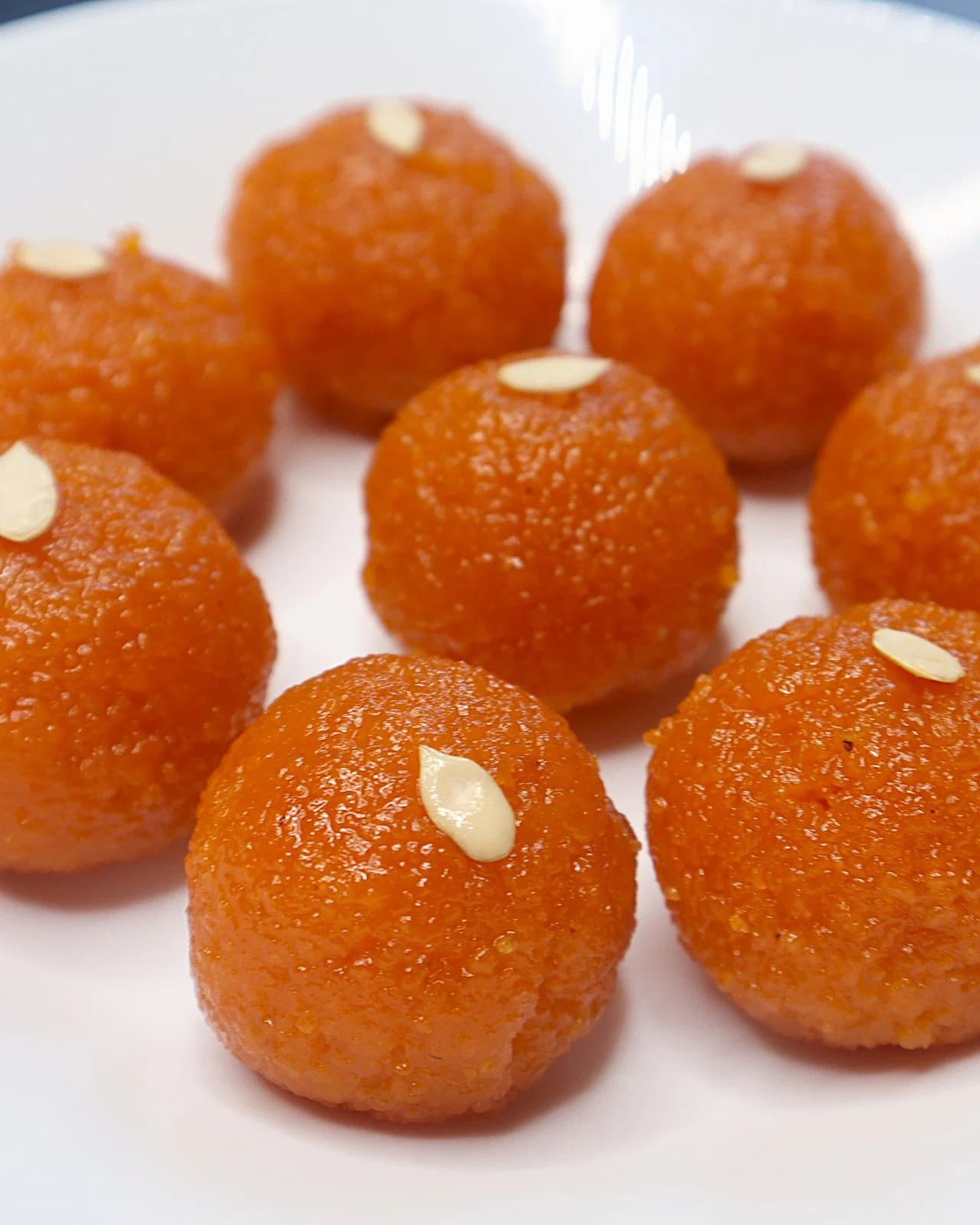
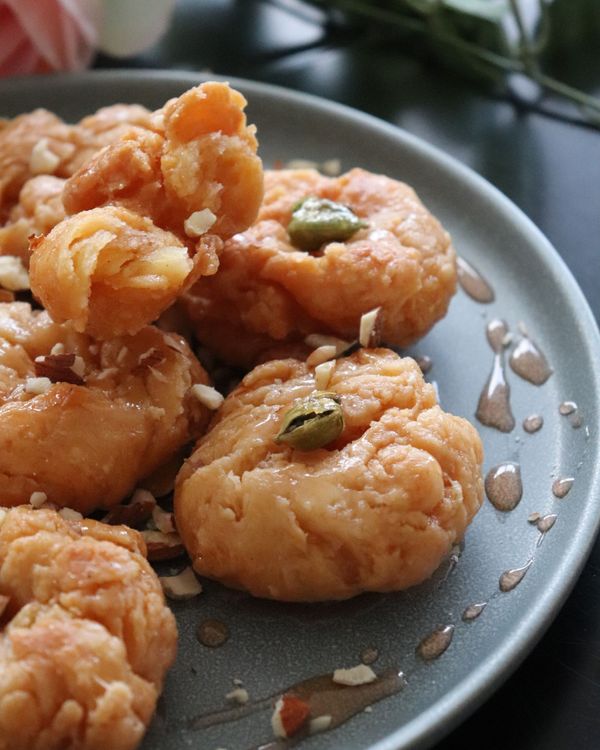
Grease your palms with ghee. Take a portion of the warm mixture and press firmly to form round laddus.
Store the finished laddus side-by-side in a wide, flat container rather than stacking them.

Want to keep this recipe for later? We can email it to you!
In between batches, flip the ladle upside down and clean it thoroughly with water so the tiny 0.5mm holes stay completely unclogged.
What is the purpose of using patika or lemon juice in the syrup?
Patika or lemon juice prevents crystallization of the sugar syrup.
Can I use melon seeds or charoli instead of cashews?
Yes, you can substitute cashews with melon seeds or charoli.
Why is it important to use a specialized ladle for making boondi?
The specialized ladle with 0.5mm holes is essential for creating the tiny, pearl-like droplets needed for authentic motichoor laddus.
How should I store the finished laddus?
Store the finished laddus side-by-side in a wide, flat container rather than stacking them, as they are extremely soft and delicate.
What should be the consistency of the batter?
The batter should be smooth, lump-free, and have a thin, free-flowing consistency similar to thick buttermilk.

I’m Rajani, a passionate cook with over 15 years of experience creating delicious, approachable dishes. My love for food began in childhood, inspired by watching Sanjeev Kapoor’s Khana Khazana with my mom and helping her in the kitchen. On The Gourmet’s Hut, I share tried-and-tested authentic Indian recipes and quick microwave mug cake recipes perfect for busy days. My goal is to make cooking simple, flavorful, and fun—because food brings people together and every meal should create memories.
...