We use cookies on this website to ensure its proper functioning and to improve the quality of our services. Cookie Policy

Tags and nutritional info are auto-generated and may be inaccurate. Always check the full ingredient list before cooking.


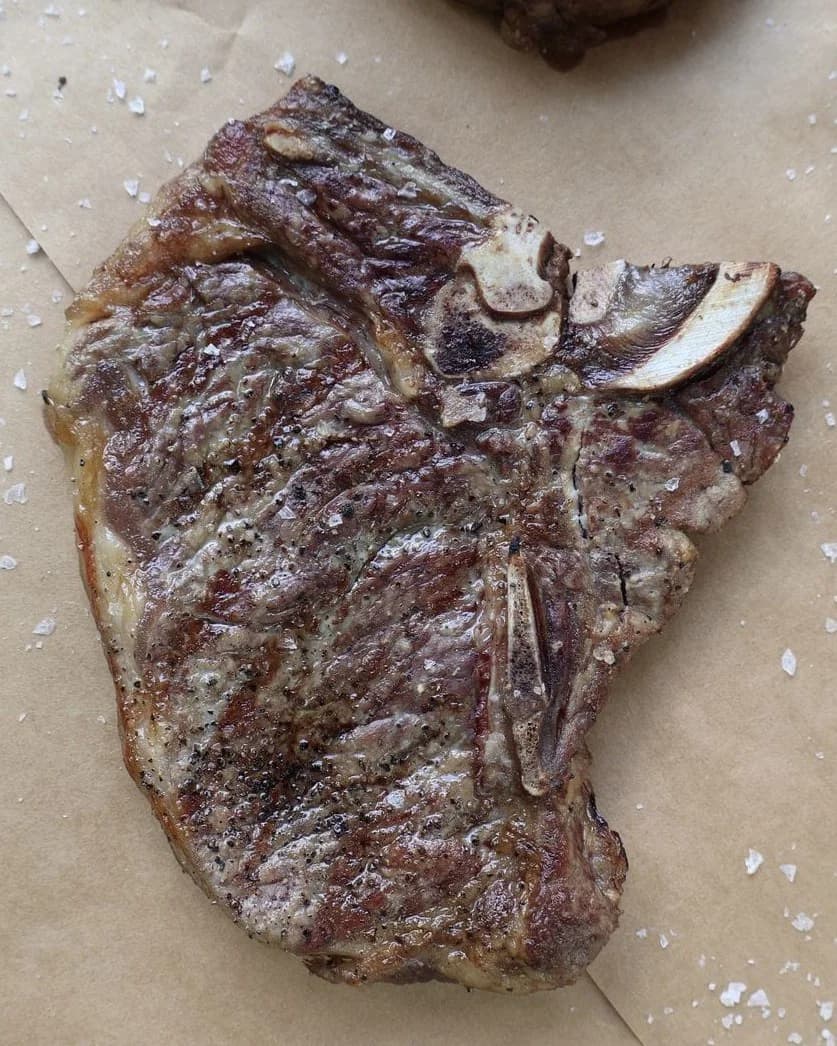
Take the T-bone out of the fridge 30 to 45 minutes before cooking. Pat it completely dry with paper towels.

Rub the steak all over with the avocado oil.
Season both sides and the edges with the kosher salt and black pepper.
Set up a grill with a hot direct-heat zone and a cooler indirect zone. Indoors, heat a cast iron skillet over high heat and preheat the oven to 400F.

Sear the steak over the hot zone for 2 to 3 minutes per side, until both sides have a deep, dark crust. Sear the fat edge too.

Move the steak to the indirect zone, or transfer the skillet to the 400F oven, with the smaller tenderloin side angled away from the hottest heat.
Finish until the strip side reaches your target. For medium rare, pull at 125 to 130F measured in the thickest part of the strip, away from the bone.

Move the steak to a board and rest for 5 to 10 minutes.
Carve the strip and tenderloin off the bone and slice each across the grain.
Sprinkle the sliced steak with flaky sea salt and serve.
Want to keep this recipe for later? We can email it to you!
Measure in the strip side, away from the bone - the bone insulates the meat near it and the lean tenderloin runs a few degrees ahead of the strip.
Pull early - pulling at 125-130F lands you at a final 130-135F for medium rare after the rest.
A thicker steak (1.75 inches and up) does well reverse-seared: start over indirect heat to come up slowly, then finish with a hard sear over the hot zone.
Grill or cast iron: a two-zone grill gives char, a little smoke, and full control over the two muscles; indoors, sear hard in a screaming-hot cast iron skillet and finish the whole skillet in a 400F oven.
Substitutions: a porterhouse is the same cut with a bigger tenderloin - cook it the same way, giving a thicker one a little more time over indirect heat; a cast iron skillet plus a 400F oven replaces a two-zone grill; any neutral high-smoke-point oil such as refined canola or light olive oil (skip extra-virgin and butter); any flaky sea salt for finishing.
Why should the tenderloin side be angled away from the hottest heat?
The lean tenderloin cooks faster than the strip, so angling it away from the hottest heat helps prevent overcooking.
What is the recommended internal temperature for medium rare?
For medium rare, pull the steak at 125-130F, which will rise to 130-135F after resting.
Can I use a different oil instead of avocado oil?
Yes, you can use any neutral high-smoke-point oil such as refined canola or light olive oil.
How should leftovers be stored and reheated?
Refrigerate sliced leftovers in an airtight container up to 3 days. Warm slices in a low 250F oven just until heated through.
What is the difference between a T-bone and a porterhouse steak?
A porterhouse is the same cut as a T-bone but with a larger tenderloin section.