We use cookies on this website to ensure its proper functioning and to improve the quality of our services. Cookie Policy
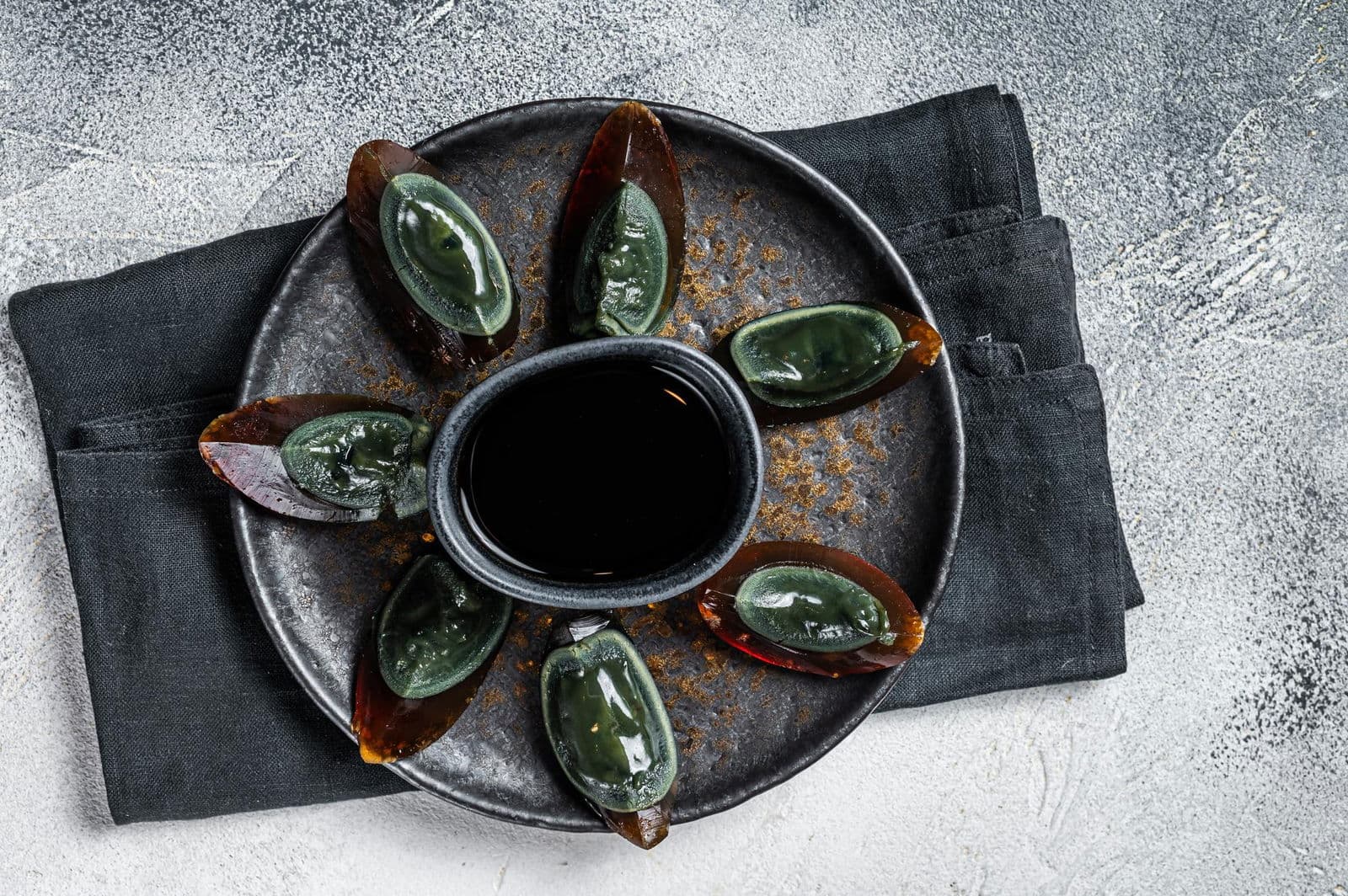
If you've ever seen a jet-black egg with a dark green yolk on a dim sum menu, you've already met the century egg. It looks like something out of a horror movie. It smells faintly of sulfur. And yet, it has been a beloved part of Chinese cuisine for over 600 years.
Before you scroll past it, here's what you should know: the century egg is not rotten, not made with horse urine (yes, that myth exists), and definitely not preserved for a hundred years. It's a preserved egg with a rich, complex, umami-packed flavor that has earned its place at tables across China, Hong Kong, Taiwan, and Southeast Asia.
This guide covers everything, from what century eggs actually taste like to how they're made, whether they're healthy, and the best ways to eat them.
A century egg, also known as preserved egg, pidan (皮蛋), thousand-year egg, or pine flower egg, is a traditional Chinese delicacy made by curing duck, chicken, or quail eggs in an alkaline mixture of clay, ash, salt, quicklime, and rice hulls. The process takes weeks to a few months, not a century.
Through this chemical process, the egg white transforms into a dark amber or brownish-black jelly with a firm, gelatinous texture. The yolk turns a deep greenish-grey with a soft, creamy center. The whole egg takes on a rich, savory, slightly sulfuric aroma that is very much the point.
You can find the full ingredient profile for century eggs on Chefadora, including storage tips and recipe ideas.
Century eggs are sometimes called pine flower eggs because the curing process can leave snowflake-like crystal patterns on the surface of the egg white. These are not a sign of spoilage. They're a sign of a well-made batch.
Century eggs taste salty, savory, and deeply umami. The egg white is mild on its own, with a firm, jelly-like bite. The yolk is where most of the flavor lives. It is creamy, rich, and complex, similar to the funkiness of a blue cheese or aged parmesan, with a faint hint of ammonia that softens when paired with other ingredients.
The smell is more intense than the taste. Once you get past the aroma, the egg itself is far less dramatic than expected. Most first-timers are surprised by how much they enjoy it when it's served with pickled ginger, soy sauce, or cold tofu.
The texture is the biggest adjustment for people new to century eggs. The white is like a firm jelly, and the yolk is almost custardy. If you enjoy dishes with varied textures, this is actually a big part of the appeal.
Century eggs do not actually take a century to make. Not even close. Traditional methods take around two to three months. Modern commercial methods can produce a finished century egg in as little as ten days to a few weeks using a sodium hydroxide solution.
The name is more about the dramatic transformation than the time. An egg that emerges looking black, smelling of sulfur, and tasting like aged umami has clearly been through something. The "century" is poetic.
In the traditional method, raw eggs are coated in a paste of wood ash, clay, salt, and quicklime, then rolled in rice hulls to prevent sticking, and stored in sealed containers. As the alkaline mixture slowly raises the pH of the egg to around 9 to 12, the proteins break down and reform into something entirely new.
The science behind century eggs is actually fascinating. The transformation agent is alkalinity. As the pH of the egg rises during curing, complex proteins and fats break down into smaller, more flavorful compounds. The egg white darkens through a process similar to the Maillard reaction, the same one that browns your toast. The yolk turns green-grey as sulfur compounds interact with the proteins.
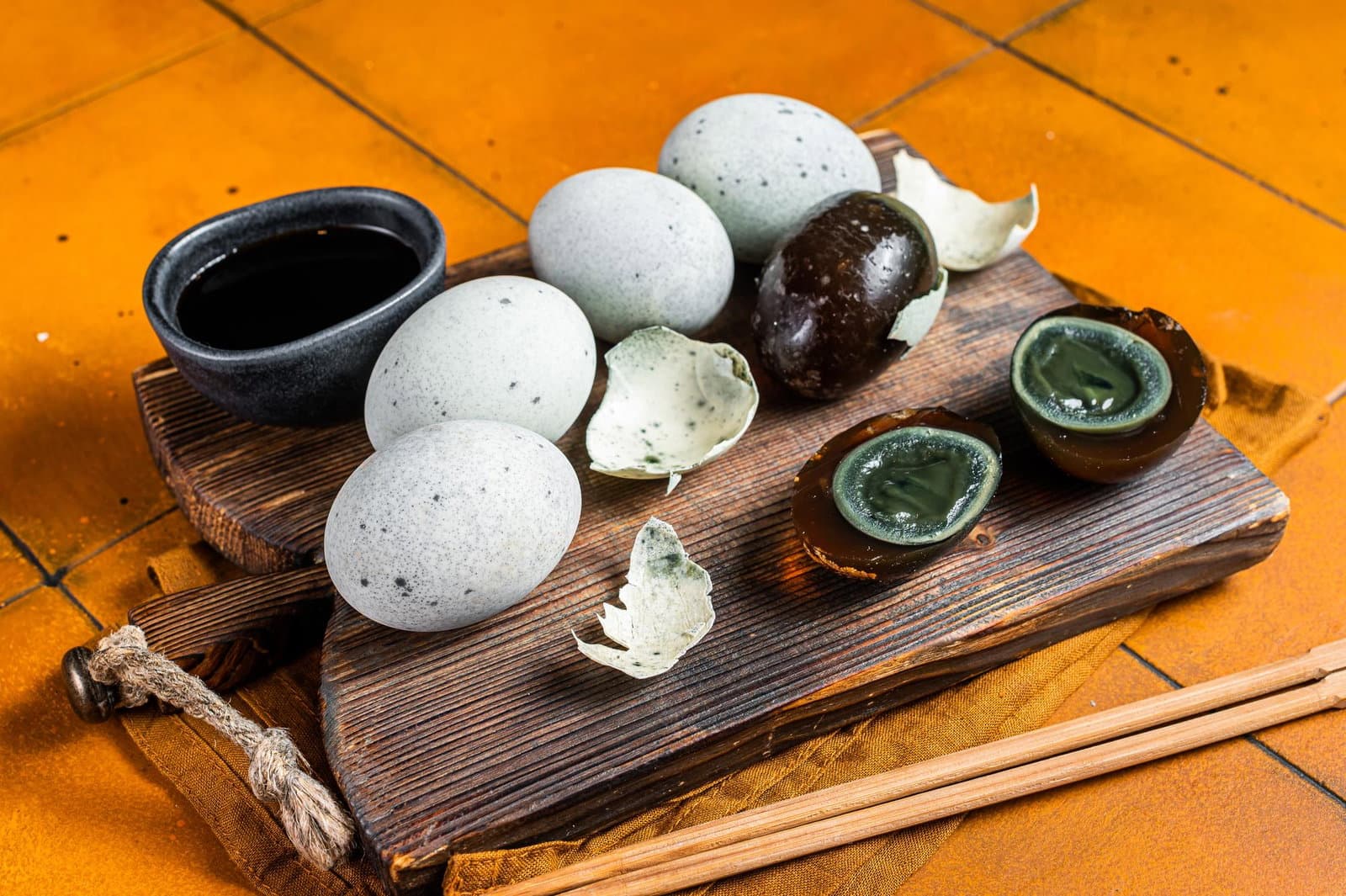
Traditional recipes use calcium oxide (quicklime), wood ash, sea salt, and strong black tea. Modern producers soak eggs in a liquid solution of sodium carbonate, calcium hydroxide, and salt, which speeds up the process significantly.
One real concern with century eggs has been the historical use of lead oxide to speed up curing. This is toxic and was used by some producers in the past. Today, zinc oxide is the standard alternative. When buying century eggs, especially imported ones, look for labels that say lead-free. Products sold in the US and most Western markets are held to food safety standards that prohibit lead.
Century eggs are more nutritious than their reputation suggests.
In some ways, yes. Compared to regular eggs, preserved eggs are lower in calories, fat, and carbohydrates, and higher in protein and iron. A single duck century egg contains roughly 92 calories, 7 grams of fat, and 8 grams of protein. They also provide selenium, which supports immune function, and phosphorus, which is important for bone health.
Research has also found that century eggs contain compounds that may help reduce LDL cholesterol and triglyceride levels, as well as anti-inflammatory properties. One study found that gastrointestinal digests of preserved eggs showed potential activity against cancer cell lines, though this research is early-stage and not a reason to eat them as medicine.
Century eggs do contain cholesterol, around 450 mg per 100 grams, which is significant. However, dietary cholesterol has a more complex relationship with blood cholesterol than once thought. For most people, eating century eggs occasionally as part of a balanced diet is not a concern.
The bigger nutritional caution is sodium. The curing process makes century eggs high in salt, around 440 mg per egg. If you have high blood pressure or are watching sodium intake, keep portions moderate.
Century eggs began as a preservation method. Before refrigeration, people needed ways to make food last. Coating eggs in alkaline clay extended their shelf life dramatically, from a few weeks to over a year. What started as practical food storage evolved over centuries into a beloved culinary tradition.
The Chinese eat century eggs because they are genuinely delicious when prepared well. They add a depth of umami flavor to simple dishes like congee and cold tofu that is hard to replicate with anything else. They also carry deep cultural meaning, appearing at banquets, family meals, and traditional celebrations.
In China, century eggs are a staple, not a novelty. They appear in street food, dim sum, home cooking, and high-end restaurants. The cultural comfort with preserved and fermented foods runs deep, the same way kai chutney made from red ants carries generations of tradition in Odisha, India, or casu marzu, Sardinia's live-maggot cheese, remains a point of cultural pride. Foods that look unusual from the outside often tell the richest stories.
Century eggs need no cooking. You simply peel the shell and rinse the egg briefly under cold water. Because the yolk is very soft and creamy, a knife can make a mess of the cut. The cleanest method is to slice it with unflavored dental floss or a wet blade.
Here are the most popular ways to eat century eggs:
To make it: dice or slice 1 to 2 century eggs and place over 300g of silken tofu. Mix together 2 tablespoons soy sauce, 1 teaspoon sesame oil, 1 teaspoon rice vinegar, and 1 teaspoon minced ginger. Drizzle over the top. Serve cold.
If you enjoy fermented and aged umami flavors, you will likely take to century eggs faster than you expect. Think of them the way you might think of natto, miso, or aged cheese: an acquired taste that rewards curiosity. Speaking of which, if you're on a journey through bold fermented foods, our blog on Natto - The Japanese Superfood is worth a read.
Century eggs are available at most Asian or Chinese grocery stores. They're usually in the refrigerated section or near other preserved foods, sold in packs of four to six, often individually wrapped in plastic. Look for eggs with no cracks and check the expiration date.
Some stores still sell them coated in the traditional clay-and-ash casing. If you see a brownish paste around the egg, that's normal. Rinse it off, crack the shell, and peel.
For those without nearby Asian grocers, century eggs are also sold online. Look for brands labeled lead-free and produced in countries with food safety oversight.
Store unopened century eggs in a cool, dry place. Once opened, keep them refrigerated in an airtight container. They have a naturally long shelf life of several months.
Q1. Can I eat a century egg without boiling it?
A1. Yes. Century Egg is fully cured and ready to eat straight from the shell, so no additional cooking is required.
Q2. Is a century egg full of bacteria?
A2. No. During the curing process, the egg is preserved in an alkaline mixture that raises the pH to a level where harmful bacteria cannot survive. A properly prepared Century Egg is safe to eat and free of harmful bacteria or mold.
Q3. What does a century egg smell like?
A3. A Century Egg usually has a mild to moderate smell of ammonia and sulfur. This comes from protein breakdown during curing. The smell tends to be stronger than the taste. If the odor is extremely strong or unpleasant, it may indicate the egg was not properly prepared.
Q4. What country eats the most eggs overall?
A4. China leads the world in egg consumption. This high demand is one reason preserved egg traditions—such as Century Egg—developed and remained popular there for centuries.
Q5. Is it healthy to eat century eggs regularly?
A5. In moderation, yes. Century Egg contains protein, iron, and selenium, which can contribute to a balanced diet. However, they can also be high in sodium, so it’s best to consume them in moderation—especially for people managing blood pressure.
Q6. How is a century egg different from a salted egg?
A6. Salted Egg is cured in a brine solution, producing a firm, salty yolk often used in dishes like mooncakes or congee. A Century Egg uses an alkaline curing process that dramatically changes the egg’s color, texture, and flavor. Both are preserved eggs, but they look and taste very different.
Century eggs are one of those foods that deserve more credit than their reputation gives them. They are ancient, clever, and genuinely delicious. Give them a fair shot, especially with good pickled ginger or over cold silken tofu, and you may find yourself adding them to your regular grocery list.
Updated on 20 Aug 2026

Save recipes from anywhere, and get answers, swaps, and help as you cook.

