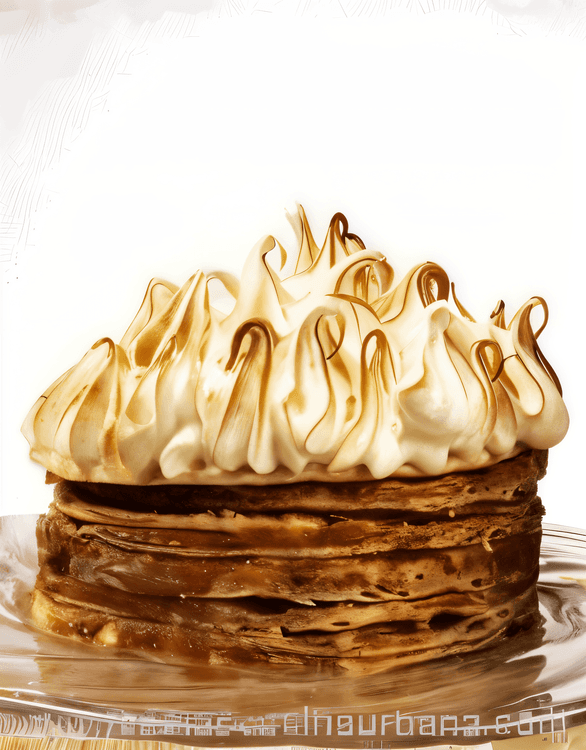
Sharing a traditional handcrafted alfajor filled with dulce de leche and covered with meringue, the Rogel is of Argentine origin and has a history spanning over forty years, thanks to María del Rosario and Ricardo Balbiani. They were the ones who began making this type of alfajor, inspired by a European recipe and also by one sold at a shop in the Belgrano neighborhood. The classic Rogel is a four-layer alfajor with dulce de leche...
Chefadora AI has the answer - timers, swaps, step-by-step help.


In a bowl, sift the flour with the salt and form a well in the center.
Add the heavy cream to the center and mix until a dough forms. Be careful not to overwork the dough.
Divide the dough into 8 equal portions, place them on a tray, cover with a cloth, and let them rest for one hour in a cool place.
Roll out each portion with a rolling pin on a lightly floured surface, forming circles about 20 cm in diameter and 1 mm thick.
Place the circles on a greased baking sheet and prick them with a fork.
Bake in a preheated oven at 180°C for about 10 minutes.
Remove from the oven and let cool.
Place one dough circle on a serving plate and spread a layer of dulce de leche on top.
Cover with another dough circle and repeat the process until all the circles are stacked, finishing with a dough circle on top.
In a bowl, combine the egg whites and sugar.
Place the bowl over a double boiler, stirring constantly until the mixture is warm and the sugar dissolves completely.
Remove from the heat and beat with an electric mixer until the meringue becomes glossy and holds stiff peaks.
To decorate the alfajor, transfer the meringue to a piping bag fitted with a star tip and pipe small peaks close together over the surface.
Place the alfajor in a hot oven briefly to lightly brown the meringue, then remove.
Ensure the dough is not overworked to maintain a tender texture.
Use a high-quality dulce de leche for the best flavor.
When making the meringue, ensure the sugar is fully dissolved to achieve a smooth texture.
If you don't have a piping bag, you can use a plastic bag with a small hole cut in one corner.
Store the alfajor in a cool place to maintain its texture and flavor.
Can I use store-bought dulce de leche?
Yes, store-bought dulce de leche works perfectly for this recipe. Just ensure it is of good quality for the best results.
How do I know when the meringue is ready?
The meringue is ready when it becomes glossy and holds stiff peaks when you lift the mixer.
Can I make the dough circles ahead of time?
Yes, you can bake the dough circles in advance and store them in an airtight container until ready to assemble.
What can I use if I don’t have a double boiler?
You can use a heatproof bowl placed over a pot of simmering water, ensuring the bowl does not touch the water.
How should I store the alfajor?
Store the alfajor in a cool, dry place. If the weather is warm, you can refrigerate it, but allow it to come to room temperature before serving.